


 Encomium
The Senate Committee on Legislative Compliance has concluded a two-day workshop in Abuja focused on closing the persistent gap between legislative resolutions and implementation by Ministries, Departments, and Agencies (MDAs). The event brought together lawmakers, regulators, and private sector leaders to explore solutions to Nigeria’s compliance crisis, which has contributed to widespread inefficiencies across key sectors, including infrastructure and healthcare.
In his opening address, Senate President Godswill Akpabio, represented by Senator Osita Ngwu, described it as a crisis of culture. “It is abnormal in a democracy when public institutions ignore or selectively implement resolutions of the National Assembly,” he said. “Why do resolutions passed by the legislature sit dormant in ministry files, unattended to? Compliance should not be optional — it should be the default.”
Participants echoed this sentiment throughout the workshop. Senator Garba Maidoki, Chairman of the Committee, underscored the impact of non-compliance on national development. “We have over ten thousand abandoned projects in the country, with trillions of naira pumped halfway and no result,” he said. “If you travel by road, you see the consequences. If you visit hospitals, the effects of non-compliance are painfully clear — services are simply not delivered to Nigerians.”
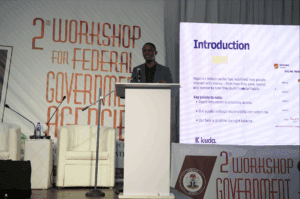
From the private sector, Rasaq Kadri, Head of Compliance at Kuda, delivered a keynote on the role of fintechs in driving responsible innovation. He stressed that while technology has expanded access to financial services, true inclusion must be built on a foundation of accountability. “Fintech has redefined financial access,” Kadri said. “But access without responsibility can deepen risk. Inclusion means combining reach with reliability.”
Citing Kuda’s approach, he shared how embedding compliance into product design has enabled the company to innovate confidently and securely. Kadri also called for stronger collaboration between regulators and fintechs, noting that outdated regulatory frameworks often fail to reflect digital-first financial models. “Compliance and innovation don’t have to be at odds. When done right, they reinforce each other,” he said.
The workshop spotlighted several urgent areas for reform — from capacity building within MDAs to modernising regulatory frameworks and enforcing sanctions for non-compliance. Participants also called for strengthening performance monitoring units within the presidency to ensure ministries are held to account.
The gathering concluded with a consensus that Nigeria’s progress hinges not just on passing laws, but on implementing them, with every stakeholder, public and private, playing a role.